On Theros, looking up at night means looking toward the home of the gods.
That starry realm is Nyx, a place where dreams, belief, and divine power meet. Its appearance inspired the MTG Nyx frame: the starfield treatment introduced on enchantment creatures and enchantment artifacts in Theros in 2013.
What began as a detail rooted in MTG lore eventually became the default look for enchantments on Magic's standard card frame. To understand that history, start with the sky that inspired it.
What Is Nyx in Magic: The Gathering Lore?
In Magic: The Gathering lore, Nyx is both the night sky of Theros and the realm of its gods. Theros draws on Greek mythology, with heroic quests, dangerous monsters, rival city-states, and a pantheon whose disagreements rarely end well for mortals.
Nyx makes that divine world visible. When a god appears in the mortal realm, parts of its body reveal a starfield where shadow would normally fall, as though the figure occupies two worlds at once.
Three ideas help explain its place in Theros lore:
- Dreams connect mortals to Nyx. The people of Theros say that dreamers visit the gods' realm while they sleep.
- The gods are living enchantments. Their supernatural nature connects the plane's mythology directly to its card types.
- Enchantment magic is associated with divine gifts. A blessing, a god's weapon, or a starlit servant can all express the influence of Nyx.1
Creatures born from this realm are known as the Nyxborn. Their starry appearance gives a simple visual clue: something from the divine world has entered the mortal one.2

Theros, 2013. Illustrated by Jaime Jones.
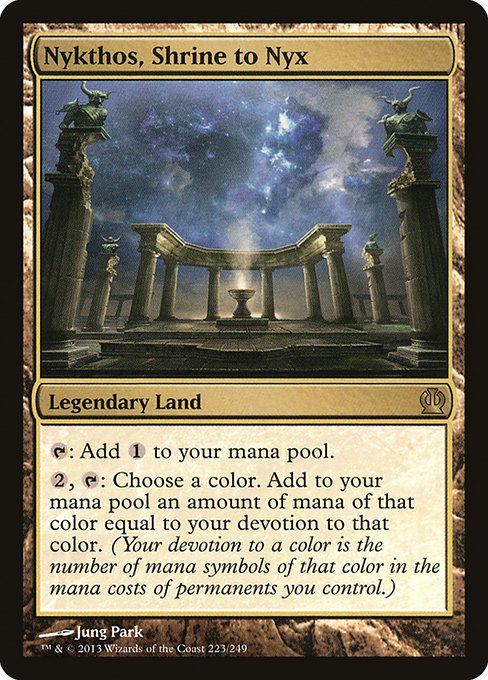
Theros, 2013. Illustrated by Jung Park.

Journey into Nyx, 2014. Illustrated by Daarken.
Heliod, a shrine powered by devotion, and Kruphix, keeper of the mysteries of Nyx. Card images © Wizards of the Coast, shown via Scryfall.
The Gods of Theros and the Power of Belief
The original Theros block introduced five monocolored God cards: Heliod of the sun, Thassa of the sea, Erebos of the Underworld, Purphoros of the forge, and Nylea of the hunt. Ten two-color God cards completed the block's fifteen-card pantheon.
Their power depends on mortal belief. In the story Kruphix's Insight, Kruphix reveals that the gods themselves emerged from beliefs given form within Nyx. Faith sustains them, and changes in what mortals believe can threaten even a god's place in the world.3
Devotion translates that idea into gameplay. The original Theros God cards remain enchantments, but on the battlefield they are only creatures when your devotion to their color or colors reaches the required amount.
Kruphix is especially closely associated with Nyx. He can appear as a silhouette filled with stars, and his temple stands at the edge of the world. His knowledge of the way into Nyx becomes crucial to Elspeth's journey.4
Elspeth, Xenagos, and the Journey into Nyx
The original Theros story turns the power of belief into a threat to the gods themselves.
Xenagos, a satyr Planeswalker, discovers that he can harness mortal devotion to ascend to godhood. His transformation into the god of revels reveals an uncomfortable truth: the pantheon is not beyond change, and its members can be challenged.
Elspeth Tirel sets out to stop him, wielding Godsend, the weapon Heliod reforged from her sword. Accompanied by Ajani, she seeks Kruphix's guidance and ultimately enters Nyx to confront Xenagos. She kills the newly ascended god, but Heliod betrays her after her victory, striking her down with her own weapon.45
In Theros Beyond Death (2020), Elspeth fights her way out of the Underworld with Shadowspear, a weapon born from a nightmare. By convincing the dead that her spear is Heliod's true weapon, she turns their belief against him. His spear shatters, Erebos imprisons him beneath a giant boulder, and Elspeth earns passage back to the mortal world.6
These events show why Nyx matters: on Theros, what people believe can reshape the world. The starfield on its cards gives that extraordinary idea a visible form.

Born of the Gods, 2014. Illustrated by Jason Chan.

Journey into Nyx, 2014. Illustrated by Daniel Ljunggren.

Theros Beyond Death, 2020. Illustrated by Ryan Yee.
The god Elspeth defeated, the weapon she carried, and a Saga depicting her return. Card images © Wizards of the Coast, shown via Scryfall.
Why Theros Introduced the Nyx Frame
When Theros released in September 2013, enchantments were central to both its mythology and its gameplay. The gods were enchantment creatures, their emissaries could bestow blessings, and their signature weapons were enchantment artifacts.
That last group included Spear of Heliod, Bident of Thassa, Whip of Erebos, Hammer of Purphoros, and Bow of Nylea.
These cards needed to communicate two card types at once. A creature might also be an enchantment; a divine weapon might be both an artifact and an enchantment. The starfield helped players recognize that overlap at a glance.
It also carried the story onto the card face. The same sky that appeared within a god's body now appeared around the artwork.7

Theros, 2013. Illustrated by Yeong-Hao Han.

Born of the Gods, 2014. Illustrated by Eric Deschamps.

Journey into Nyx, 2014. Illustrated by Min Yum.
Early Nyx frames: a divine weapon, a creature with bestow, and an enchantment creature with constellation. Card images © Wizards of the Coast, shown via Scryfall.
Two details explain how the original frame worked:
- The frame itself had no rules effect. The card's types and rules text determined how it played.
- Ordinary enchantments used the regular frame. Auras and other enchantments that were neither creatures nor artifacts did not receive the starfield treatment.7
Enchantment creatures also existed before Theros. Lucent Liminid, printed in Future Sight in 2007, was an earlier example. Theros made them a major theme and gave them a recognizable visual identity.8
Devotion, Bestow, and Constellation
The Nyx frame appeared alongside mechanics that made enchantments central to play:
- Devotion counts relevant mana symbols in the mana costs of permanents you control. For the original Theros gods, it determines whether they are creatures on the battlefield.
- Bestow lets you cast certain enchantment creatures as Auras. When a bestowed permanent is no longer attached, it becomes a creature again.
- Constellation, introduced in Journey into Nyx, rewards enchantments entering the battlefield under your control.79
The stars do not grant any of these abilities. They help you spot the card type those abilities care about.
Nyx Frame History: From Theros to Foundations
Over the next decade, the Nyx frame expanded from a visual signature of Theros into a more general way to identify enchantments.
| When | What changed |
|---|---|
| 2013–2014: The original Theros block | Theros, Born of the Gods, and Journey into Nyx use the starfield on enchantment creatures and enchantment artifacts within the card frame of that era. |
| Later reprints | The treatment is adapted to the updated M15-era card face while retaining its starfield identity. |
| 2020: Theros Beyond Death | The return to Theros uses a slightly revised Nyx frame. Mark Rosewater also discusses the possibility of a general enchantment-creature frame.10 |
| 2022: Kamigawa: Neon Dynasty | Wizards explicitly extends the starry treatment to enchantment creatures across the Multiverse.11 |
| November 2024: Magic: The Gathering Foundations | The Nyx treatment becomes the default frame for noncreature enchantments too, including ordinary enchantments and Auras.12 |

Theros Beyond Death, 2020. Illustrated by Lius Lasahido.

Kamigawa: Neon Dynasty, 2022. Illustrated by Tuan Duong Chu.
The Nyx treatment in Theros Beyond Death and Kamigawa: Neon Dynasty. Its use on Kamigawa shows how a look inspired by one plane became useful across Magic. Card images © Wizards of the Coast, shown via Scryfall.
The Neon Dynasty change widened the frame's setting. The Foundations change widened its purpose: stars could now identify an enchantment even when it had no other card type.
Banishing Light makes that shift easy to see. Its original Journey into Nyx printing uses the regular frame. Its Foundations printing uses the starfield treatment. The card remains an enchantment; the visual convention changed.

Journey into Nyx, 2014. Illustrated by Willian Murai.

Foundations, 2024. Illustrated by Willian Murai.
Banishing Light in 2014 and 2024: the same enchantment, with two different frame conventions. Card images © Wizards of the Coast, shown via Scryfall.
This is a default treatment, so you will still encounter other looks. Showcase and borderless cards, specialized layouts such as Sagas and Classes, and reprints that preserve older presentations can differ.
Nyx Frame vs. Regular MTG Frame
The most noticeable difference is the starfield texture around the artwork. On a typical Nyx card, bright points appear near the top of the frame and continue along its sides.
Most of the familiar reading structure remains:
- The name and mana cost stay at the top.
- The type line stays beneath the artwork.
- The rules text remains in the usual text box.
- The card's color treatment remains recognizable beneath the stars.
- A modern legendary crown can carry the starfield treatment as well.
That makes the frame useful as a visual cue. Players can recognize an enchantment while reading the card in the same familiar order.
The original 2013–2014 version sits within the older card face used by the Theros block. Later versions adapt the effect to the M15-era layout. When comparing details, use cards from the same frame era; otherwise, you may be comparing a broader redesign as well as the Nyx treatment.
When Should a Custom MTG Card Use the Nyx Frame?
For custom MTG cards, choose the frame that matches both the type line and the era you want to evoke.
- For a current standard-frame look: Nyx is the usual choice for enchantments, including Auras, enchantment creatures, and enchantment artifacts.
- For an original Theros or pre-Foundations look: use Nyx for enchantment creatures and enchantment artifacts, while keeping ordinary enchantments on the regular frame.
- For a card without the Enchantment type: use a frame that communicates its actual types. Players familiar with the starfield will associate it with enchantments.
Specialized layouts, such as Sagas, can call for their own treatment.
Nyx lore can also inspire the design itself. A creature that embodies a dream, a divine blessing, or an idea brought to life might make a compelling enchantment creature.
That choice has gameplay consequences: being an enchantment opens up enchantment synergies and makes the permanent vulnerable to effects that affect enchantments. Build those interactions into your design alongside its appearance.
For more on the gameplay side, see How to Design Custom Enchantments and Artifacts and MTG Card Types Explained.
Create a Nyx-Frame Card in PipGlyph
In PipGlyph's MTG card creator, choose Nyx under Variations.
The treatment supports ordinary enchantments, Auras, enchantment creatures, and enchantment artifacts. Legendary cards can use a matching starfield crown.
A few details help you choose the right look:
- New enchantments start with the Nyx treatment. You can switch to the standard frame when you want an older style.
- Selecting Nyx on a creature or artifact adds Enchantment to its type line. This keeps the visual treatment and card types aligned.
- Existing cards keep their saved appearance until you choose to change it.
- Imported cards follow the selected printing's frame treatment, preserving the distinction between older and newer enchantment presentations.
The frame itself has no rules effect, but adding Enchantment to the type line does. A creature that gains that type becomes an enchantment creature, with the interactions that come with both types.
Nyx Frame FAQ
Does the Nyx Frame Change How a Card Works?
The frame itself does not. Card types and rules text determine how a card works. An enchantment with a regular frame follows the same rules as the same card with a Nyx frame. In PipGlyph, selecting Nyx on a creature or artifact also adds the Enchantment type, which does affect gameplay.
Which Cards Use the Nyx Frame Today?
Since Magic: The Gathering Foundations in November 2024, it is the default treatment for enchantments on the standard frame, including Auras and noncreature enchantments. Alternate treatments, specialized layouts, and some reprints can use other presentations.
Is the Nyx Frame Only for Theros Cards?
No. It originated in Theros lore, but Kamigawa: Neon Dynasty extended the starfield treatment to enchantment creatures across the Multiverse in 2022. Foundations later extended the default treatment to noncreature enchantments.
What Is the Difference Between Nyx and the Underworld?
In MTG lore, Nyx is the starry realm of the gods. The Underworld is the realm of the dead, ruled by Erebos. Elspeth's story takes her to both, but they are distinct places.13
Can I Use the Nyx Frame in PipGlyph?
Yes. Choose Nyx under Variations in the card creator. Selecting it on a creature or artifact adds Enchantment to the type line.
How Does the Original Theros Nyx Frame Differ from Today's?
The starfield idea is the same, but it sits within different generations of Magic's card face. Original Theros cards use the frame of the 2013–2014 era; later printings adapt the treatment to the M15-era layout.
Footnotes
-
Wizards of the Coast, Planeswalker's Guide to Theros, Part 1. ↩
-
Wizards of the Coast, Planeswalker's Guide to Born of the Gods. ↩
-
Kelly Digges, Kruphix's Insight. ↩
-
Wizards of the Coast, Planeswalker's Guide to Journey into Nyx. ↩ ↩2
-
Wizards of the Coast, The Theros Beyond Death Story on Cards. ↩
-
Wizards of the Coast, Theros Beyond Death Story Summary. ↩
-
Wizards of the Coast, Theros Mechanics. ↩ ↩2 ↩3
-
Mark Rosewater, Future Sight Design Handoff Document. ↩
-
Wizards of the Coast, Mechanics of Journey into Nyx. ↩
-
Mark Rosewater, More Odds & Ends: Theros Beyond Death. ↩
-
Wizards of the Coast, Kamigawa: Neon Dynasty Mechanics. ↩
-
Magic: The Gathering Foundations — Changes, MTG Wiki. Its reference identifies Wizards' June 2024 MagicCon Amsterdam preview panel as the announcement source. Release date corroborated by Wizards' First Look at Magic: The Gathering Foundations. ↩
-
Wizards of the Coast, Planeswalker's Guide to Theros, Part 3. ↩